
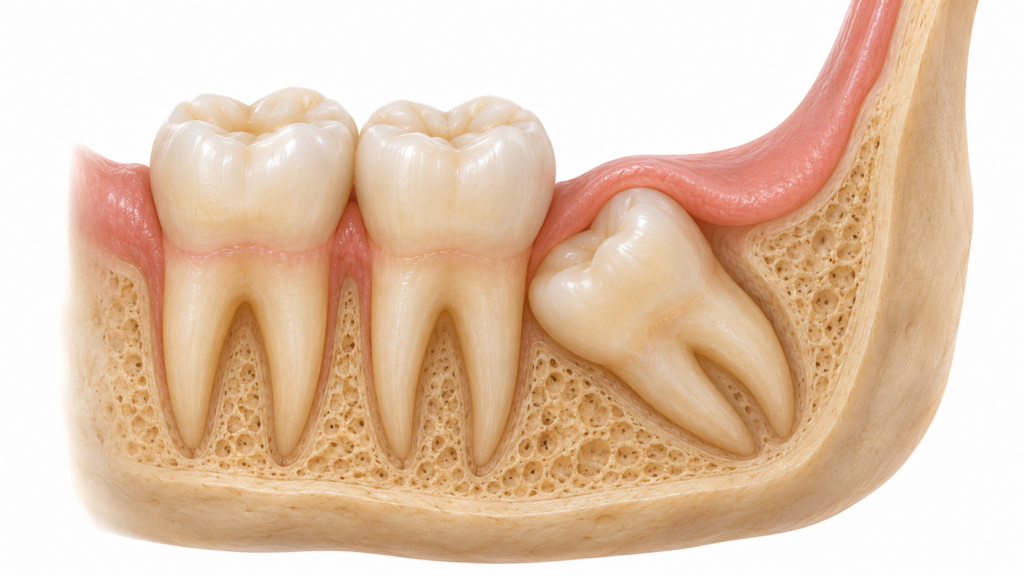
Impacted wisdom teeth may need removal when they cause pain, infection, decay, gum disease, damage to a neighboring tooth, or other identifiable problems. A wisdom tooth that causes no symptoms does not automatically need to come out, but it still needs evaluation: some problems develop without noticeable pain. A dentist can examine your mouth and review appropriate X-rays to help you weigh removal against monitoring.
What is an impacted wisdom tooth?
Wisdom teeth are the third molars, located at the back of the mouth. They usually emerge in the late teens or early adulthood. A tooth is impacted when it cannot come through the gum into a functional position, often because there is not enough room.
An impacted wisdom tooth may remain completely beneath the gum or partially emerge. It may be upright, tilted toward the tooth in front of it, or positioned at another angle. Not every impacted tooth causes trouble, but its position can make it difficult to clean or affect the neighboring tooth.
Signs that a wisdom tooth needs attention
Symptoms can come and go, so discomfort that improves on its own is still worth discussing with a dentist. Possible signs of a problem include:
- Pain or tenderness at the back of the mouth
- Red, swollen, or bleeding gum around a partially erupted tooth
- A bad taste or persistent bad breath
- Difficulty opening your mouth comfortably
- Food repeatedly becoming trapped behind the last molar
- Pain or sensitivity in the neighboring tooth
These symptoms can have other causes, too. An examination is needed to determine whether a wisdom tooth is responsible and what treatment is appropriate.
When to seek urgent care
Contact a dentist promptly if you have worsening pain, swelling, fever, or trouble opening your mouth. Seek emergency medical care if swelling is spreading or you have difficulty breathing or swallowing. These can be signs of a serious infection.
When is removal usually recommended?
A dentist may recommend removing an impacted wisdom tooth when an examination or X-ray shows disease, damage, or a risk that is significant enough to outweigh the risks of surgery. Common reasons include:
- Repeated or significant infection: A partially erupted tooth can trap bacteria beneath a flap of gum tissue, causing inflammation called pericoronitis.
- Tooth decay: Decay may develop in the wisdom tooth or the molar in front of it, especially where the area is difficult to clean or restore.
- Gum or bone damage: Plaque around an impacted tooth can contribute to gum disease or loss of supporting bone.
- Damage to the neighboring tooth: An impacted tooth may contribute to decay, bone loss, or damage to the root of the adjacent molar.
- A cyst or other abnormal finding: A cyst can occasionally form around an unerupted tooth and damage nearby structures. An unusual finding needs further evaluation.
- Problems with function or treatment: Removal may be considered if the tooth interferes with biting or with another necessary dental procedure.
Not every episode of gum irritation means the tooth must be removed immediately. Depending on the cause and severity, a dentist may first clean the area, recommend appropriate home care, or treat an infection. Antibiotics may be needed in some cases, but they do not replace dental treatment of the source of an infection.
Can impacted wisdom teeth be monitored instead?
Yes. If a wisdom tooth is free of disease and is not causing other problems, monitoring can be a reasonable option. The dentist can check the tooth and surrounding gum during regular visits and recommend X-rays when appropriate for your circumstances.
The advantage of monitoring is avoiding surgery that may not be necessary. The limitation is that problems can develop later, sometimes without obvious symptoms. Follow-up also requires a commitment to regular dental care; the interval between examinations or X-rays is individualized rather than the same for everyone.
Preventive removal is sometimes considered even when a tooth is not currently causing symptoms. The evidence does not support a single decision for every symptom-free impacted tooth. Its position, the health of the neighboring molar, your ability to clean the area, surgical risks, and your preferences all matter. Ask your dentist what specific benefit removal would offer in your situation and what could happen if you choose monitoring.
How does a dentist evaluate an impacted wisdom tooth?
The evaluation typically starts with questions about symptoms and a visual examination of the tooth, gums, and neighboring molar. An X-ray helps show the tooth’s position, its roots, and nearby structures that cannot be seen during the exam.
For lower wisdom teeth, the dentist also considers how close the roots are to a nerve. For upper teeth, the relationship to the sinus may matter. In selected cases, additional three-dimensional imaging may help clarify anatomy, but it is not necessary for everyone.
X-rays help with planning, but they cannot predict every complication or guarantee whether a symptom-free tooth will cause problems in the future.
What does removal involve?
The procedure depends on the tooth’s position and complexity. Local anesthetic is used to numb the area. Depending on the circumstances, sedation may also be discussed. A tooth beneath the gum may require an incision, removal of some surrounding bone, or division into smaller pieces. Stitches may be needed.
Some extractions are straightforward; others may be referred to an oral and maxillofacial surgeon. Your dentist can explain the proposed approach, anesthesia options, and whether a referral is appropriate. If you have sedation, follow the care team’s instructions about eating beforehand and arranging a responsible adult to take you home.
Benefits, risks, and recovery
Removal can address an existing source of infection or damage and may prevent future problems associated with that tooth. It is still surgery, so the expected benefit should be weighed against the risks.
Common short-term effects include discomfort, swelling, and some bleeding. Possible complications include infection and dry socket, a painful condition that can occur when the protective blood clot is lost or disrupted. Less commonly, nerve injury can cause altered sensation in the lip, chin, tongue, or nearby areas; this is often temporary but can be longer-lasting or permanent. Upper tooth removal can occasionally affect the sinus.
Recovery varies with the procedure and the individual. Your care team will provide instructions for managing discomfort, eating, cleaning the area, and protecting the blood clot. Contact them if symptoms worsen or you have concerns during recovery.
Frequently asked questions
Can an impacted wisdom tooth cause no pain?
Yes. A tooth can be impacted without hurting, even when changes are developing around it. That is why the decision to remove or retain it should be based on an examination and appropriate imaging, not pain alone.
Will an impacted wisdom tooth straighten itself out?
Its position can change as it develops, especially in younger patients, but an impacted tooth does not reliably move into a healthy position. A dentist can assess its current position and whether observation is reasonable.
Can I keep a partially erupted wisdom tooth?
Sometimes. The decision depends on whether the tooth and surrounding gum are healthy, whether you can clean the area effectively, and whether the neighboring tooth is affected. Partially erupted teeth can be harder to keep clean and may be more prone to recurring gum inflammation.
Do all four wisdom teeth have to be removed at once?
No. Each tooth should be evaluated individually. Some patients need one or several removed, while others may be able to keep and monitor them. If more than one needs treatment, your dentist can discuss the practical benefits and limitations of treating them together or separately.
Discuss your options with a dentist
If you have symptoms or questions about impacted wisdom teeth, an examination can help clarify whether treatment or monitoring makes sense. Learn more about wisdom teeth removal in Canby, or schedule a consultation with Holly Street Dental in Canby, Oregon, to discuss your options.